
 Taking a walk down Krakow’s Memory Lane
-
Taking a walk down Krakow’s Memory Lane
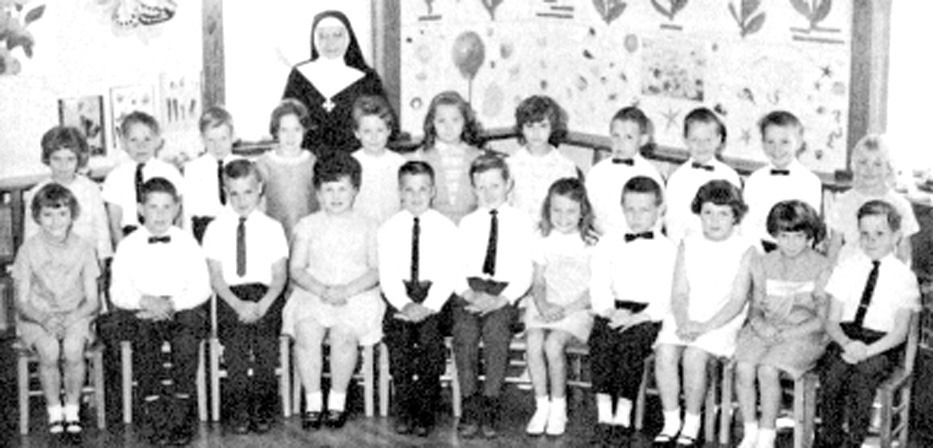
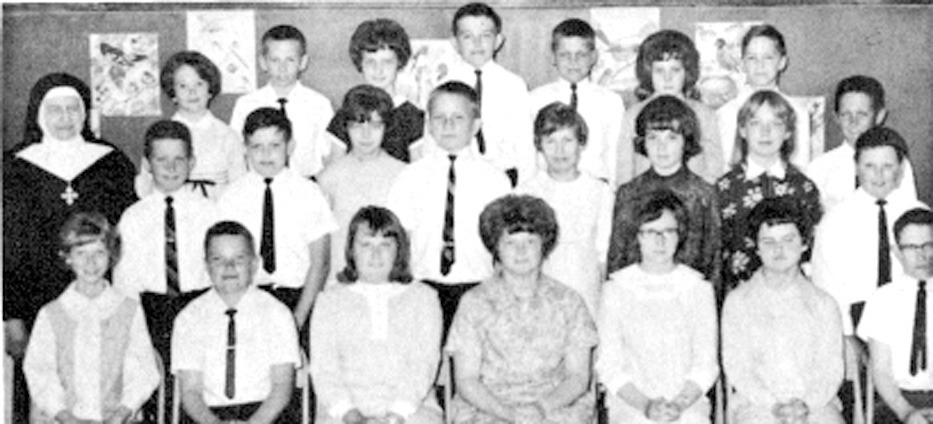
GRADES ONE THROUGH FOUR – Front row, from left: Judy Koziol, John Cuba, Leonard Boryca, Selena Ziemba, Kenneth Boryca, Roger Yrkoski, Bridget Borowiak, Ronald Vetick, MaryLu Vetick, Margaret Ziemba, and Ronald Valasek. Back row: Joanne Bialas, Charles Voichoskie, Jerome Yrkoski, Barbara Yrkoski, Roxanne Bialas, Dorothy Czarnick, Kathleen Bialas, Donald Vetick, Kelly Kava, Gary Bialas, and Debra Brandenburger. Not pictured: Diane Lassek, David Lassek, Kenneth Czarnick, Zigmund Stankoski, and James Stankoski. Teacher: Sister Annette Marie Drozd, C.R. GRADES FiVE THROUGH EIGHT – Front row, from left: Ann Marie Czarnik, LeRoy Rinkol, Virginia Vetick, Patricia Ziemba, Irene Bialas, Karen Urkoski, and Marvin Yrkoski. Middle row: Mark Urkoski, Clifford Yrkoski, Mary Koziol, Kenneth Gonsior, Rita Yrkoski, Norma Ann Boryca, Julie Brandenburger, and Joseph Vetick. Back row: Bertilla Voichoskie, Robert Bialas, Christine Urkoski, Ronald Cuba, William Ziemba, Marcia Urkoski, William Kava, and Gary Urkoski. Not pictured: John Czarnick, Rodney Czarnick, and David Brandenburger. Teacher: Sister Timothea Reinert, C.R.
The records of Sts. Peter & Paul Parish in Krakow is meager. The St. Stanislaus Parish in Duncan records that the first Polish settlers at Duncan arrived directly from Europe as early as 1869. From this was created a new parish in Krakow, two miles southwest of Genoa.
That same year, Father Anastasium Czech had a meeting at the Vitalis Borowiak farm, 69 family heads being present. The place on the John Szatkowski’s (Shotkoski) farm was selected for the church and two acres of the new church would be Sts. Peter & Paul–Krakow. The congregation at Duncan was then divided into three distinct parishes: Duncan, Krakow, and Pilzno.
Although several of the families who had settled in this vicinity had come from Krakow, Poland, a greater number had come from Tarnow; but, because there already was a place in Nebraska called Tarnov, the new settlers of his territory decided to call the place Krakow (Cracow) after the very large city of Krakow in Poland.
Since no church had been erected until 1894, Sunday Mass was celebrated in the Martin Borowiak home northeast of the present church. The first wedding of the parish, that of Mike Sock and Eva Szymowicz, took place in another private home, that of Witalis Borowiak. In 1895, the first resident pastor, Father Wegrzynowski, arrived. That same year, a convent for the Sisters was erected.
In 1901, construction for the new church began and a rectory was built in 1909.
Around 1912, a time when refrigerators were still not known and food had to be kept from spoiling, the solution was digging and building two ice-houses – one for the Sisters and one for the pastor. In winter, the ice was hauled from the river in large slabs by the men of the parish, placed into dugouts, and covered thickly between layers with straw to prevent thawing. This ice was used year-round in the ice-boxes.
The year 1922 saw the erection of a school and boarding house, Sister’s living quarters and chapel. The first church, which to this time also served as a school, was torn down.
Since people came to church by means of horse and buggy, in 1925 a huge barn was built on the grounds. One section of the barn was used for a chicken coop for the Sisters’chickens. These helped supply the boarders with fresh eggs and chicken meat. When the boarding school was discounted in 1956, it was no longer necessary to raise chickens and the barn was torn down. That same year, the parishioners suggested installing a telephone at the rectory, but the resident priest at that time, Father Edward Soliwoski, declined because he felt he would not make sufficient use of a phone.
Under the direction of Father Stefan Flisiak who arrived in 1956, many necessary improvements were made, including a clothes dryer purchased for the Sisters in 1958, and a new rectory and social hall built in 1967.
Today, the church at Krakow is well attended. Parishioner and lector Dale Lassek of Silver Creek recently commented that the church is so full some Sundays, he jested that “we’re going to have to build on” – a sure sign that the country church is well and flourishing.