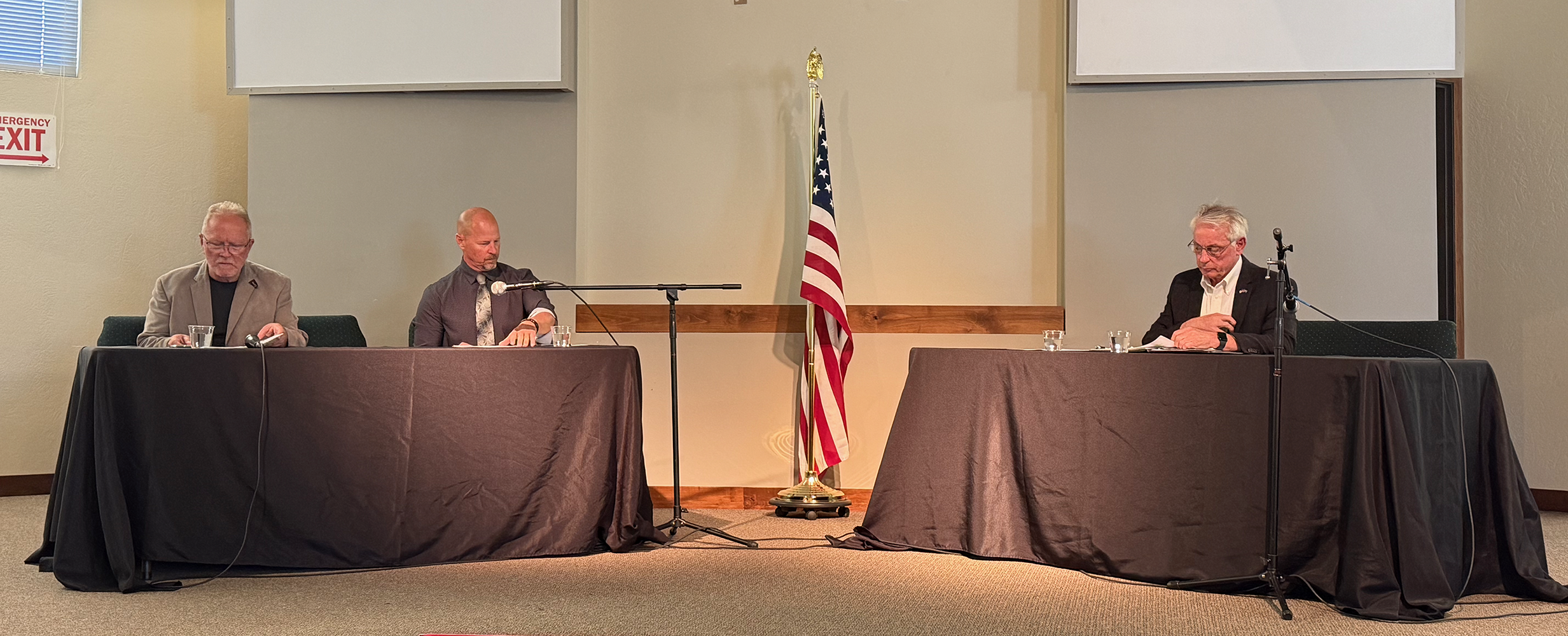
 Interconnection Systems Inc. President and CEO Wayne Williams (left) and Central City Schools Superintendent Jeff Jensen joined State Senator Loren Lippincott for a roundtable discussion last week. NCJ photo by Rick Holtz
CENTRAL CITY — State Senator Loren Lippincott had the opportunity last week to speak to voters at a NEGOP Roundtable.
The event brought Lippincott, Central City Schools Superintendent Jeff Jensen and Interconnection Systems Inc. President and CEO Wayne Williams together to discuss issues affecting Nebraska and district 34. The roundtable was held Thursday at ISI Corporate Offices in Central City.
The discussion touched on Nebraska’s budget, school funding, the teacher shortage facing Nebraska school districts and how the state can help small businesses. About 45 people were on hand for the roundtable. A detailed breakdown of the questions and answers can be found below.
District 34 NEGOP Roundtable
Senator Lippincott represents Nebraska’s 34th Legislative District where he has served since January 2023. The Senator brings a background as a fifth-generation Nebraska farmer, U.S. Air Force veteran, and retired commercial airline captain to his role. During his legislative years, he has infused his work with a strong emphasis on rural priorities, fiscal conservatism, and traditional values. As a member of the Appropriations Committee, he has played a key role in navigating budget challenges, including advancing property tax relief and fiscal reforms, protecting women’s sports; family values, supporting Educators and retirement security, boosting rural economic development and infrastructure, promoting second amendment rights and pro-life protections, plus the Senator promotes community engagement by hosting regular town halls.
MODERATOR: Senator, do you plan to implement hard spending caps on state appropriations to prevent growth beyond the cost-of-living index and population increases, and what specific agencies or programs would you target for cuts to balance the budget without raising taxes?
LIPPINCOTT: Yes, I absolutely plan to push for hard spending caps on state appropriations. We’ve seen government bloat at all levels, and Nebraska needs to lead by example. To balance the budget without raising taxes—a non-negotiable for me—we’d have to prioritize cuts to non-essential programs and inefficiencies. Nebraska’s General Fund budget for FY2025-26 is about $5.5 billion, with major chunks going to health and human services (around 37%), education (about 25%), and higher ed like the University of Nebraska (13%). We can’t touch core services like public safety or roads, but there’s fat to trim elsewhere. Here’s what I’d target specifically: Health and Human Services (DHHS): This is our biggest spender at over $2 billion in General Funds annually, mostly on Medicaid and welfare programs. I’d aim to cut administrative overhead by at least 10-15% through streamlining bureaucracy and implementing stricter eligibility audits to reduce fraud and waste in public assistance. Senator Hardin and director Corsi are combing through the DHHS budget and uncovering a multitude of fraud and diagnosing the areas of waste. We could save hundreds of millions without hurting truly needy families by promoting work requirements and transitioning able-bodied recipients to private sector jobs.
Education (NDE and related aid): K-12 aid eats up about $1.3 billion, but a lot goes to administrative bloat and non-core programs. I’d target cuts to things that duplicate local or private efforts. Instead, redirect savings to property tax relief for schools. I’d push for a 5-10% reduction in administrative and non-academic spending, like diversity, equity, and inclusion offices or underutilized programs that don’t align with workforce needs. Focus on in-state tuition affordability and trade skills.
Other Non-Essentials for cuts like the Tourism Commission (around $10 million in cash funds) let private marketing handle promotion. And any lingering environmental or arts funding (minimal but present in agencies like Game and Parks or the Arts Council) gets zeroed out if it’s not directly tied to conservation or jobs. It’s about prioritizing: protecting farmers, families, and small businesses while shrinking the government. I’ve worked with appropriations to cut where we can, and I’m committed to having a balanced budget that fulfills the needs of our communities.
MODERATOR: Senator, in light of recent efforts to sweep cash from agencies and tap into the cash reserve, what measures would you support in the Appropriations Committee to address budget deficits while prioritizing tax relief for Nebraskans?
LIPPINCOTT: I’ve been vocal about the need for disciplined budgeting that puts taxpayers first. We’ve seen tax receipts come in below projections for FY2025, leading to a projected $95.4 million shortfall. To address this without burdening Nebraskans with higher taxes, we took steps in the 2025 session like sweeping over $135 million in cash funds from various agencies and tapping into the Cash Reserve Fund to close a $262 million biennial gap. These were necessary measures to flatten budgets and avoid immediate deep cuts, but they’re not sustainable long-term. Our Cash Reserve stands strong at around $921 million projected for the end of the biennium, built precisely for times like these after years of prudent saving
Moving forward, I’d support several targeted measures in the Committee to tackle deficits head-on while accelerating tax relief—because every dollar we save through efficiency should go back to hardworking families, farmers, and small businesses via lower taxes. Here’s what I’d push for:
Expanded Cash Fund Sweeps with Oversight: Build on the recent $150-160 million sweeps by identifying additional underutilized agency funds, like those in the Department of Economic Development or non-essential earmarks in Health and Human Services. We’d require audits to ensure sweeps don’t impair core functions, aiming for another $50-100 million in the mid-biennium adjustment. This keeps the government lean without broad tax hikes.
Targeted Spending Reductions and Flat Funding: Advocate for 5-10% cuts across non-core programs, prioritizing areas like administrative overhead in Medicaid (which ballooned our shortfall). Flat budgets for most agencies, as we did this year, would hold the line on growth—saving tens of millions that could fund property tax credits under LB 34 or similar relief measures.
QUESTION from Central City School Superintendent Jeff Jenson:
Senator, given the Education Future Fund is projected to deplete within five years, what measures will the Appropriations Committee take in the 2026 session to protect foundation aid and special education reimbursements for rural districts like Central City? Our District is one that has greatly benefitted from this funding after losing equalization aid of nearly $2 million back in 2010 to $0 for the last ten years up until this funding became available. In addition, our District has grown 150 students over the past 5 years and this funding is imperative.
Lippincott Answer: Rural districts just like ours have relied on the Education Future Fund to bridge gaps left by the TEEOSA formula, especially after losing out on equalization aid. Our growth of 150 students over five years is a testament to the vitality of our rural communities, and we can’t let funding shortfalls undermine that progress. The Fund, created in 2023 with an initial $1 billion transfer, has been a game-changer by providing foundation aid at $1,500 per student and boosting special education reimbursements to 80% of costs—up from just 42% before. But you’re right: projections show it could deplete by 2027-28 or 2028 if we don’t act, as annual spending (around $250 million in transfers) is outpacing growth amid rising costs.
In the 2026 session, the balance we will need is to safeguard these critical supports for rural schools without resorting to tax hikes or bloating the budget further. Here’s what I plan to advocate for: Sustainable Revenue Infusions Tied to Growth: We’ll prioritize redirecting any surplus from economic development or federal matching funds into the Fund, aiming to build it toward Governor Pillen’s goal of $2.5 billion by 2029-30. This could include exploring one-time transfers from underutilized cash reserves elsewhere in the state budget, similar to our recent sweeps, to extend the Fund’s life while we work on long-term fixes. No new taxes—just smarter allocation of existing resources.
Efficiency Reforms and Accountability: To stretch dollars further, I’ll back zero-based budgeting reviews for the Department of Education and push for audits of special ed spending to root out waste without reducing reimbursements.
Opposition to Diversions and Bloat: I’ll fight any attempts to raid the Fund for non-core initiatives, like programs that duplicate local efforts, and instead redirect savings toward property tax relief tied to school funding—because strong schools and low taxes go hand-in-hand for Nebraska families.
JEFF JENSON: The teacher shortage is real, and this isn’t an issue; it is a catastrophic issue. What will you do to support the growth of the prospective teacher pool?
LIPPINCOTT: You’re absolutely right; the teacher shortage in Nebraska isn’t just a challenge, it’s a crisis threatening the future of our kids and communities, especially in rural areas where nearly 670 positions went unfilled at the start of the 2024-25 school year.
Expand Alternative Certification and Apprenticeship Pathways: I’ll push to broaden programs like the Nebraska Teacher Apprenticeship Program, which invests $1 million annually to help paraprofessionals earn degrees while working in schools. This gets experienced aides into classrooms faster without the red tape of traditional routes. We should also streamline certification for career-changers, military veterans, and out-of-state teachers to cut bureaucracy and attract talent quickly.
Reduce Union Mandates and Empower School Choice: Work to reform laws around teacher’s unions, like allowing opt-out options from national affiliations, to give educators more freedom and reduce forced dues that deter entry. Expanding school choice options, including charters and opportunity scholarships, will create competitive environments that attract innovative teachers and improve overall quality.
Remove Qualification Hurdles. Advocate for revising restrictive certification requirements that block qualified candidates. Specifically: Eliminate Unnecessary Testing Barriers: Reform or remove Praxis exam requirements for experienced professionals with proven subject-matter expertise, such as STEM professionals or retirees with advanced degrees, allowing them to demonstrate competency through work experience or portfolio assessments.
Simplify Reciprocity for Out-of-State Teachers: Amend Nebraska’s certification rules to fast-track licensing for teachers from other states, reducing redundant coursework and paperwork while maintaining standards.
JEFF JENSEN: Bond issues have become increasingly difficult to pass. Are their proposals for incentives to help districts fund building improvements for safety and increased efficiency? Our current elementary is nearly 100 years old and costs our district over $300,000 more per year because it is inefficient and repairs to roofs, windows, HVAC, and other systems are necessary. Is there any additional funding that will be available to leverage these needs similar to what we did with the Dome?
LIPPINCOTT Your reference to the Bison Activity Dome at Central City High School is spot on—that project was a smart success story, blending local bonds with a substantial $4 million FEMA grant to create a dual-purpose gym and tornado shelter without overwhelming taxpayers. It’s exactly the kind of leveraged funding we need more of. We need creative solutions for proposals that provide similar incentives to help districts fund safety and efficiency upgrades, focusing on grants and partnerships rather than mandates or new taxes.
The School Safety and Security Fund: $10 million was distributed in 2024 to 122 districts for infrastructure improvements. We could allocate an additional $20-30 million from existing budget surpluses or the Education Future Fund, prioritizing rural districts with aging facilities. This mirrors the FEMA approach for the Dome by tying funds to demonstrable needs like storm resilience or energy savings. But we don’t have the budget to do so at the moment.
Federal Matching Grants and Public-Private Partnerships: Encourage partnerships with private entities—think utility companies offering rebates for HVAC upgrades or local businesses sponsoring efficiency projects in exchange for tax credits. This keeps state spending minimal while multiplying impact.
JEFF JENSON: Early childhood care and affordable available daycare has been a huge priority for communities, but has not been a priority of the State or Federal Government. For example, our Head Start funding has been cut in half over just the last few years to $100,000 and some rural communities lost that funding all-together. Do you have current plans to address this need?
Further, our plans to move out of the elementary to one-campus would include making four spaces in the 1998 elementary addition available to address Daycare for 80 kids of our community. Would there be plans for incentives to do that? A school run daycare is too expensive and requires too many parameters, however, someone can do this privately without the red tape.
LIPPINCOTT: We must fix or see how the budget is first. IF we have funds to spend, this could be on the table. We need to continue to cut spending and re-prioritize / reorganize our priorities. This is not something that needs to be dealt with solely by the state, as there are also private institutions. We have made the background check process and fingerprinting process. We have worked with the state patrol to make this process smoother and faster. In 2022, Nebraska streamlined background checks for early childhood education by eliminating the need for some providers to reapply to the Nebraska Department of Health and Human Services (NDHHS) when changing employers. Legislative Bill (LB) 874 created a system for “portability” of background checks, allowing previously authorized individuals to provide documentation of their eligibility directly to a new employer, which simplifies the hiring process.
Regarding the innovative plan to repurpose four spaces in the 1998 elementary addition for private daycare serving 80 kids—that’s exactly the kind of community-driven approach we need, avoiding the expense and parameters of school-run programs. I fully support incentives for private operators to step in without red tape.
JEFF JENSON: This is a controversial issue, but what are your thoughts on HHS’s current practice of keeping kids of broken homes in broken homes? We have a system that is currently broken with an approach of keeping children in homes that should not be homes for kids. What types of options are there?
LIPPINCOTT: Child welfare is one of the most heartbreaking issues we face in Nebraska. I’ve heard from too many families caught in a system that’s often more focused on process than protection. The Nebraska Department of Health and Human Services (DHHS) does prioritize family preservation as a core principle, aiming to keep kids in their homes whenever safely possible through programs like Alternative Response, which assesses families without a full investigation to provide support and prevent removal. This aligns with federal guidelines under the Family First Prevention Services Act and our state’s 2025-2029 Child and Family Services Plan, which emphasizes prevention, in-home services, and reunification to avoid unnecessary separations. But you’re right: when homes are truly broken—plagued by abuse, neglect, addiction, or instability—the current approach can sometimes drag on too long, putting kids at risk while bureaucracy grinds slowly. We’ve seen cases where repeated interventions fail, leading to prolonged trauma, and our system needs real reform to prioritize child safety over endless preservation attempts. From my perspective, the government shouldn’t be in the business of breaking up families lightly, but neither should it trap kids in dangerous situations under the guise of “preservation.”
Conservative values mean supporting strong families first, but when that’s not possible, we must act swiftly to protect the innocent. It must be handled on a case by case basis.
WAYNE WILLIAMS: Senator, with the FY2026-2027 biennium budget addressing a projected $262 million deficit, what priorities will the Appropriations Committee set for funding renewable energy grants or tax incentives, such as those supporting local solar projects that enhance grid stability and rural economies?
LIPPINCOTT: When it comes to funding renewable energy grants or tax incentives—like those for local solar projects that could enhance grid stability and support rural jobs—our Committee will set priorities that align with their principles: encourage private investment and innovation while living within our means. Nebraska doesn’t have a dedicated statewide solar rebate or grant program, but we do benefit from federal incentives like the 30% Investment Tax Credit (ITC) under the Inflation Reduction Act, which runs through 2032 and has driven projects like community solar arrays in rural areas without state dollars. Utilities like OPPD and LES offer their own rebates (up to $1,500 for solar installations), and federal programs such as the Rural Energy for America Program (REAP) provide grants and loans for rural renewables, covering up to 50% of costs for solar systems that improve energy efficiency on farms. That said, amid a deficit, I won’t support new or expanded state-funded grants or incentives that add to our spending burden— we’ve got to cut, not grow, government subsidies.
WAYNE WILLIAMS: in light of recent compromises on bills like LB1370 imposing new requirements on wind and solar facilities—including transmission lines and generation standards—what safeguards or funding allocations are planned to ensure these don’t hinder innovative, community-scale solar developments while meeting Nebraska’s growing energy needs?
LIPPINCOTT: Rural co-ops, farms, and communities can pursue smaller solar arrays without the added regulatory hurdles, allowing innovation to thrive. For instance, projects under 100 MW aren’t subject to the mandatory weather mitigation plans or retirement notifications for dispatch-able generation, keeping costs down and timelines feasible. Federal Incentives like REAP and ITC: Direct rural projects toward the USDA’s Rural Energy for America Program (REAP) grants, which cover up to 50% of costs for solar installations that improve farm efficiency and grid resilience, and the 30% federal Investment Tax Credit (ITC) extended through 2032. I’ll push for state guidance to streamline applications, ensuring community solar isn’t hindered.
Utility and Private Partnerships: Encourage public power districts like OPPD and NPPD to expand their rebate programs (up to $1,500 per installation) and net metering policies for small-scale solar, tying into LB1370’s framework for reliable interconnections without new mandates on smaller projects.
WAYNE WILLIAMS: With emerging discussions on agrivoltaic technologies combining solar with agriculture, what appropriations or policy incentives do you foresee for supporting such hybrid projects in Nebraska’s rural districts to boost farm revenues and renewable output?
LIPPINCOTT: Agrivoltaics is an intriguing innovation that could pair solar energy with Nebraska’s agricultural backbone, allowing farmers to generate extra revenue from land while maintaining grazing, crop production, or other uses under or around panels. I see real potential here for rural districts, where projects like sheep grazing under solar arrays could diversify income streams and enhance renewable output without sacrificing prime farmland. We’ve got examples emerging nationwide, and Nebraska’s vast Ag lands make us a natural fit, but any support must prioritize private enterprise over taxpayer-funded giveaways, especially with our $218 million biennial deficit looming for this year.
Leveraging Federal Programs for Agrivoltaics: The USDA’s Rural Energy for America Program (REAP) is tailor-made for this, offering grants up to 50% of costs for rural solar systems that integrate with farming operations, like elevated panels for crop shading or livestock shelter. With the 30% federal Investment Tax Credit (ITC) extended through 2032, farmers could see significant upfront savings—potentially stacking to cover 80% of costs for qualifying projects. The state could offer guidance to streamline REAP applications, ensuring rural districts can tap these without state spending. Note the recent USDA shift away from subsidies that displace farmland, but agri voltaics' dual-use nature should keep it eligible as it preserves ag productivity.