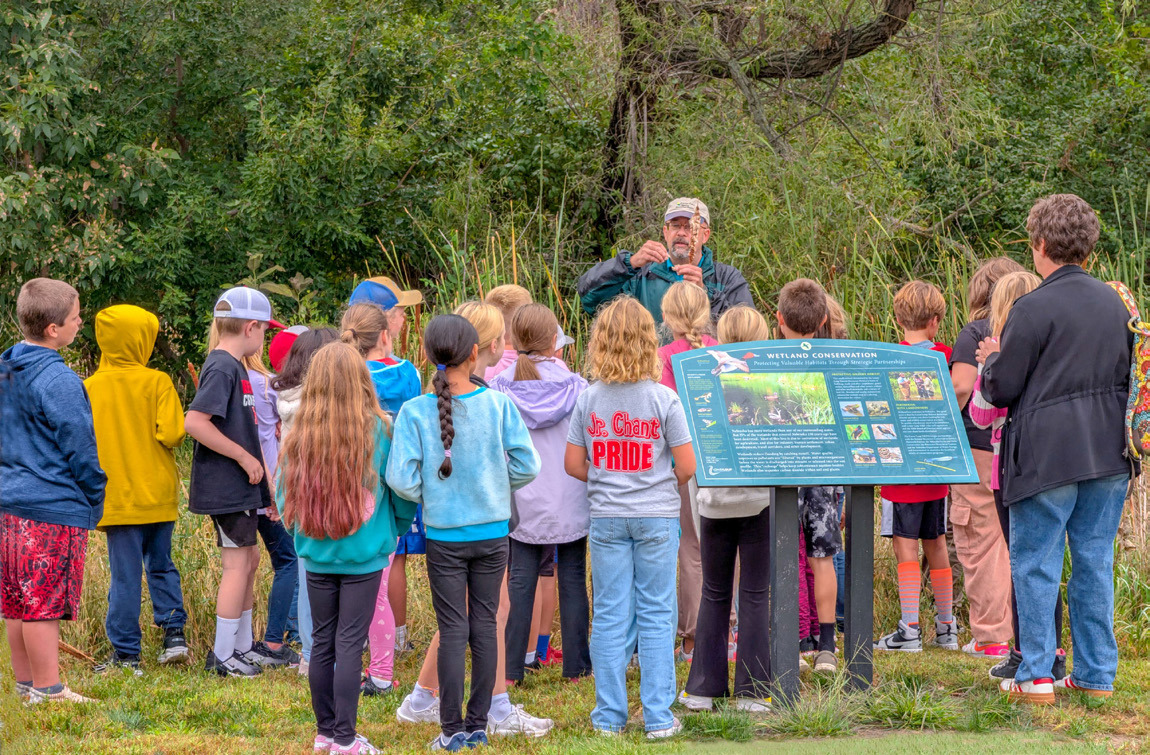
 Over the last few weeks I’ve had the opportunity to work with the third-grade class at Ord Elementary School. Brant Bechtold/LLNRD
Late summer and fall is a busy time of year for the agricultural producers who work the land and livestock within the Lower Loup Natural Resources District. It is a busy time for the Lower Loup NRD’s educators, too. One big difference is that, instead of harvesting, we are planting seeds – sort of.
Once the children of the District return from summer vacation and are back in class, we ramp up our educational programming. Over the last few weeks I’ve had the opportunity to work with the thirdgrade class at Ord Elementary School. A late spring freeze negatively impacted many of the plum bushes in our area, but that hasn’t dampened the third graders’ enthusiasm for learning about wild plums, how the Native Americans and pioneers relied on plums for food, and how important plums and plum thickets are for wildlife.
A few weeks after that classroom visit, the students rode the bus to the LLNRD Arboretum. I met them there for a nature walk that included a close up and personal exploration of plum thickets, before colleague Brant Bechtold presented a fun and educational game that showed the kids the importance of pollinators and the many threats to those creatures. After that, teachers Karla Callan and Haley Barnes treated all of us to a wild plum jelly tasting!
At another recent educational event, Brant shared his personal experience as a birdwatcher with a group of eighth graders. He led those kids on an adventurous trek, but of course the walking and chatter of a couple dozen young teenagers is enough to scare off most winged creatures. One of those kids was a knowledgeable birder.
For the rest, birding was new.
Even though few birds were observed, the students left that session with a little knowledge of an outdoor activity they can share with family and friends (or alone), and also a stronger appreciation for wildlife.
Similarly, I have recently had the opportunity to “talk turtles” with youngsters at multiple events. The children are amazed to learn that turtles predate the dinosaurs. Jaws drop when I show them fossils and shells from my personal collection, and cultural items from around the world, but the star of the show is always the small but lively common snapping turtle that I save for the very end.
Improving and protecting water quality and quantity are issues that Nebraska’s NRDs are continually working on. Turtle species do best in habitat that is clean and free from pollution. What is good for turtles is good for other wildlife species and people, too. Soil and water conservation are among the purposes and authorities assigned to Natural Resources Districts by the Nebraska Legislature. When I think of soil and water I think of mud, and how getting muddy can be fun. The Lower Loup NRD started its MUDFEST event in 2023 as a way of teaching area youth about these important natural resources.
Presenters from other NRDs and organizations come together to assist Lower Loup NRD with the event – some teach a soil activity; others present sessions about water. Heck, this year we added a forestry session since tress need soil and water. Other sessions included Water Wheel of Fortune (think of a TV game show where all of the questions are about H O), the Infiltration 2
Station where the kids use giant squirt guns to learn how water moves through soil, and a soil compaction activity that leaves the kids a little muddy.
The students rotate through six 30-minute sessions before coming together to use water and compressed air to launch pop bottles into the sky. We call that one, Water Rockets.
Next month I’ll be helping with a career event for high school students. I will share with those energetic students how people with varying backgrounds and interests can make a positive impact working in careers in natural resources fields.
Being knowledgeable about turtles or birds is not required.
All of these activities are about providing education about the natural resources of Nebraska. This is important because the youth we interact with could grow up to be NRD board members making decisions about natural resources. Others will likely cast votes later in life that will influence natural resources policies. Certainly, some will grow up to manage family farms or ranches where they will make important decisions nearly every day that will in one way or another impact our natural resources.
I think of our educational efforts as planting a seed. We don’t know what the eventual yield will be. But I hope that the natural resources education we provide, at the very least, grows into a bumper crop of appreciation for the natural world for each of the youngsters that we have the good fortune to meet.
I believe it will. I’d be plum crazy to not to.
Alan Bartels, Information & Education Coordinator